
 ,
Sissoko Aminata,
Diabate Daouda,
Diallo Fousseni,
Berthe Safiatou,
Dembele Moussa,
Samake Fasse
,
Sissoko Aminata,
Diabate Daouda,
Diallo Fousseni,
Berthe Safiatou,
Dembele Moussa,
Samake Fasse
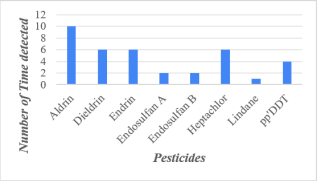
In Mali, cotton cultivation generates large quantities of cottonseed, from which edible cottonseed oil is widely produced and consumed. As part of national food safety surveillance, sanitary standards and market authorization requirements are being strengthened, necessitating routine pesticide residue assessments. This study aimed to evaluate the presence and levels of organochlorine pesticide residues in cottonseed oil marketed in Mali. A total of 27 cottonseed oil samples from different processing units were collected and anonymized by coded labeling. Laboratory analyses were conducted at the Environmental Toxicology and Quality Control Laboratory (ETQCL). Pesticide residues were extracted using the laboratory’s standard liquid–liquid extraction protocol, and quantification was performed using gas chromatography equipped with an electron capture detector (GC-µECD). Given the persistence and bioaccumulation potential of organochlorines, the investigation focused on this class of pesticides. Results indicated that 62.95% of samples were free of the targeted organochlorine residues, while 37.05% contained detectable levels. Eight out of the ten pesticides screened were identified, with concentrations ranging from 0.046 to 0.501 mg/L. DDT recorded the highest level (0.501 mg/L), whereas dieldrin showed the lowest (0.046 mg/L). Several detected concentrations exceeded the Codex Alimentarius maximum residue limits for edible oils. These findings demonstrate potential health risks associated with the consumption of contaminated cottonseed oil. It is therefore recommended to enhance pesticide regulation in cotton production, promote safer pest management alternatives, and establish regular monitoring systems to ensure oil safety for consumers.
| Published in | International Journal of Environmental Monitoring and Analysis (Volume 14, Issue 1) |
| DOI | 10.11648/j.ijema.20261401.12 |
| Page(s) | 11-16 |
| Creative Commons |
This is an Open Access article, distributed under the terms of the Creative Commons Attribution 4.0 International License (http://creativecommons.org/licenses/by/4.0/), which permits unrestricted use, distribution and reproduction in any medium or format, provided the original work is properly cited. |
| Copyright |
Copyright © The Author(s), 2026. Published by Science Publishing Group |
Cottonseed Oil, Pesticides Residues, Organochlorine, Food Safety, Mali
Pesticide | Group |
|---|---|
Aldrin | Organochlorine |
Dieldrin | Organochlorine |
Endosulfan A | Organochlorine |
Endosulfan B | Organochlorine |
Endrin | Organochlorine |
Heptaclor | Organochlorine |
Lindane | Organochlorine |
op’DDT | Organochlorine |
pp’DDT | Organochlorine |
Submitting Type | Number of Samples | Percentage (%) |
|---|---|---|
Consulting Firms | 20 | 74.07 |
Oil Processing Units | 07 | 25.93 |
Total | 27 | 100 |
Parameter | Condition |
|---|---|
Oven Initial Temperature | 70°C |
Temperature Program | 70°C → 150°C (25°C/min), then to 200°C (5°C/min), then to 260°C (10°C/min, 15 min hold) |
Carrier Gas | Nitrogen, 1.6 mL/min |
Makeup Gas | Nitrogen, 60 mL/min |
Injector Temperature | 280°C, splitless mode |
Detector Temperature | 300°C |
code | Pesticides Residues (mg/L) | |||||||
|---|---|---|---|---|---|---|---|---|
Aldrin | Dieldrin | Endosulfan A | Endosulfan B | Endrin | Heptchlor | pp’DDT | Lindan | |
Ec1 | 0,082 | ND | ND | ND | ND | ND | ND | ND |
Ec2 | 0,081 | ND | ND | ND | ND | ND | ND | ND |
Ec3 | 0,107 | ND | ND | ND | ND | ND | ND | ND |
Ec4 | 0,097 | 0,097 | ND | 0,187 | 0,085 | 0,110 | 0,244 | ND |
Ec5 | 0.097 | 0,100 | ND | 0,181 | 0,085 | 0,111 | 0,501 | 0,09 |
Ec6 | 0,099 | 0,095 | ND | ND | 0,086 | 0,116 | 0,221 | ND |
Ec7 | 0,098 | ND | ND | ND | 0,085 | 0,148 | 0,225 | ND |
Ec8 | 0,099 | 0,096 | ND | ND | 0,084 | 0,154 | ND | ND |
Ec9 | 0,094 | 0,095 | 0,157 | ND | 0,085 | 0,081 | ND | ND |
Ec10 | 0,060 | 0,046 | 0,097 | ND | ND | ND | ND | ND |
AOAC | Association of Officical Analytical Chemists |
CMDT | Malian Textile Development Company |
CVL | Central Veterinary Laboraory |
DDT | Dichloro-Diphenyl-Trichloroethane |
ECD | Electron Capture Detector |
ETQCL | Environmental Toxicology Quality Control Laboratory |
FAOSTAT | FAO's Global Statistical Database |
GC | Gas Chromatograph |
GDP | Gross Domestic Product |
MRLs | Maximum Residue Limits |
ND | Not Detected |
HUICOMA | Mali Cotton Oil Mill |
INSTAT | Mali National Institute of Statistics |
ISO | International Standardization Organisation |
USTT-B | University of Sciences, Techniques and Technologies of Bamako |
| [1] | INSTAT (2013). Agricultural Economic Survey. Malian National Institute of Statistics. |
| [2] | CMDT (2022). 2021–2022 Annual Cotton Campaign Report. Malian Textile Development Company. |
| [3] | FAOSTAT (2023). Food and Agriculture Data. |
| [4] | Traore, A., Sidibe, D., & Camara, S. (2019). Consumption and perception of cottonseed oil. |
| [5] | Keita, A. (2018). Socio-economic impact of the decline of oil mills in Mali] Revue Malienne de Developpement, 7(1), 51‑64. |
| [6] | Kone, Y., & Diarra, M. (2020). Socio-economic impact of the decline of oil mills in Mali. Cahiers du Développement Rural, 15(4), 25‑39. |
| [7] | Sangare, M., Dembele, T., & Sacko, F. (2021). The dynamics of artisanal oil mills in Mali. Bulletin de la Recherche Agroalimentaire, 9, 63‑71. |
| [8] | Diarra, S., Coulibaly, B., & Diallo, A. (2020). Use of pesticides in cotton cultivation in Mali]. Revue Africaine d’Agronomie, 12(2), 45‑54. |
| [9] | Ouedraogo, E., Traore, Y., & Sawadogo, B. (2019). Residual pesticides in cottonseed oils from Burkina Faso. International Journal of Environmental Chemistry, 99(2), 87‑95. |
| [10] | Adeyemi, J., Ibrahim, H., & Musa, A. (2021). Pesticide residues in edible oils in Nigeria : Implications for public health. Journal of Food Quality and Safety, 5(3), 112‑120. |
| [11] | Kumar, R., Patel, P., & Singh, M. (2022). Monitoring pesticide residues in edible oils in India. Food Control, 134, 108207. |
| [12] | AOAC International. (2019). Official Methods of Analysis, 21st Edition. AOAC International. |
| [13] |
Codex Alimentarius Commission. (2020). Guidelines on Pesticide Residue Analysis.
http://www.fao.org/fao-who-codexalimentarius/standards/pesticides/en/ |
| [14] | ISO 6468. (2017). Water quality—Determination of certain organochlorine insecticides, polychlorinated biphenyls and chlorobenzenes—Gas-chromatographic method after liquid-liquid extraction}, (No. ISO 6468:2017). |
| [15] | Keita, A., Coulibaly, B., & Sidibé, D. (2021). Overview of pesticide use in cotton production in Mali. International Journal of Agriculture and Environmental Research, 7(2), 35‑45. |
| [16] | Traoré, S., Diakité, M., & Coulibaly, K. (2022). Limitations in pesticide monitoring in Mali : Implications for food safety. Environmental Monitoring and Assessment, 194, 612. |
| [17] | Ouédraogo, A., Sanou, F., & Sawadogo, B. (2020). Organochlorine pesticide residues in edible oils from Burkina Faso. Food Control, 113, 107188. |
| [18] | Diawara, M., Diakite, K., Tounkara, S. M., Fane, M., Diagouraga, S., & Dicko, Y. Y. (2022). Qualite de l’huile de coton des petites unites de production au Mali. [Quality of cottonseed oil from small production units in Mali]. International Journal of Biological and Chemical Sciences, 16(1), 263-271. |
| [19] | Agbodjato, H., Akpo, E., & Sanni, A. (2021). Assessment of pesticide residues in edible oils in Benin. Journal of Food Safety, 41(3), e12874. |
| [20] | Sawadogo, L., Zongo, D., & Ouedraogo, M. (2020). Evaluation of pesticide residues in locally produced oils in Burkina Faso. Journal of Environmental Chemistry and Ecotoxicology, 12(1), 1‑9. |
APA Style
Aladiogo, M. B. M. D., Aminata, S., Daouda, D., Fousseni, D., Safiatou, B., et al. (2026). Pilot Study to Assess the Contamination of Cottonseed Oil Produced in Mali by Organochlorine Pesticide Residues. International Journal of Environmental Monitoring and Analysis, 14(1), 11-16. https://doi.org/10.11648/j.ijema.20261401.12
ACS Style
Aladiogo, M. B. M. D.; Aminata, S.; Daouda, D.; Fousseni, D.; Safiatou, B., et al. Pilot Study to Assess the Contamination of Cottonseed Oil Produced in Mali by Organochlorine Pesticide Residues. Int. J. Environ. Monit. Anal. 2026, 14(1), 11-16. doi: 10.11648/j.ijema.20261401.12
AMA Style
Aladiogo MBMD, Aminata S, Daouda D, Fousseni D, Safiatou B, et al. Pilot Study to Assess the Contamination of Cottonseed Oil Produced in Mali by Organochlorine Pesticide Residues. Int J Environ Monit Anal. 2026;14(1):11-16. doi: 10.11648/j.ijema.20261401.12
@article{10.11648/j.ijema.20261401.12,
  author = {Maiga Boubacar Madio dit Aladiogo and Sissoko Aminata and Diabate Daouda and Diallo Fousseni and Berthe Safiatou and Dembele Moussa and Samake Fasse},
  title = {Pilot Study to Assess the Contamination of Cottonseed Oil Produced in Mali by Organochlorine Pesticide Residues},
  journal = {International Journal of Environmental Monitoring and Analysis},
  volume = {14},
  number = {1},
  pages = {11-16},
  doi = {10.11648/j.ijema.20261401.12},
  url = {https://doi.org/10.11648/j.ijema.20261401.12},
  eprint = {https://article.sciencepublishinggroup.com/pdf/10.11648.j.ijema.20261401.12},
  abstract = {In Mali, cotton cultivation generates large quantities of cottonseed, from which edible cottonseed oil is widely produced and consumed. As part of national food safety surveillance, sanitary standards and market authorization requirements are being strengthened, necessitating routine pesticide residue assessments. This study aimed to evaluate the presence and levels of organochlorine pesticide residues in cottonseed oil marketed in Mali. A total of 27 cottonseed oil samples from different processing units were collected and anonymized by coded labeling. Laboratory analyses were conducted at the Environmental Toxicology and Quality Control Laboratory (ETQCL). Pesticide residues were extracted using the laboratory’s standard liquid–liquid extraction protocol, and quantification was performed using gas chromatography equipped with an electron capture detector (GC-µECD). Given the persistence and bioaccumulation potential of organochlorines, the investigation focused on this class of pesticides. Results indicated that 62.95% of samples were free of the targeted organochlorine residues, while 37.05% contained detectable levels. Eight out of the ten pesticides screened were identified, with concentrations ranging from 0.046 to 0.501 mg/L. DDT recorded the highest level (0.501 mg/L), whereas dieldrin showed the lowest (0.046 mg/L). Several detected concentrations exceeded the Codex Alimentarius maximum residue limits for edible oils. These findings demonstrate potential health risks associated with the consumption of contaminated cottonseed oil. It is therefore recommended to enhance pesticide regulation in cotton production, promote safer pest management alternatives, and establish regular monitoring systems to ensure oil safety for consumers.},
 year = {2026}
}
TY  - JOUR
T1  - Pilot Study to Assess the Contamination of Cottonseed Oil Produced in Mali by Organochlorine Pesticide Residues
AU  - Maiga Boubacar Madio dit Aladiogo
AU  - Sissoko Aminata
AU  - Diabate Daouda
AU  - Diallo Fousseni
AU  - Berthe Safiatou
AU  - Dembele Moussa
AU  - Samake Fasse
Y1  - 2026/01/30
PY  - 2026
N1  - https://doi.org/10.11648/j.ijema.20261401.12
DO  - 10.11648/j.ijema.20261401.12
T2  - International Journal of Environmental Monitoring and Analysis
JF  - International Journal of Environmental Monitoring and Analysis
JO  - International Journal of Environmental Monitoring and Analysis
SP  - 11
EP  - 16
PB  - Science Publishing Group
SN  - 2328-7667
UR  - https://doi.org/10.11648/j.ijema.20261401.12
AB  - In Mali, cotton cultivation generates large quantities of cottonseed, from which edible cottonseed oil is widely produced and consumed. As part of national food safety surveillance, sanitary standards and market authorization requirements are being strengthened, necessitating routine pesticide residue assessments. This study aimed to evaluate the presence and levels of organochlorine pesticide residues in cottonseed oil marketed in Mali. A total of 27 cottonseed oil samples from different processing units were collected and anonymized by coded labeling. Laboratory analyses were conducted at the Environmental Toxicology and Quality Control Laboratory (ETQCL). Pesticide residues were extracted using the laboratory’s standard liquid–liquid extraction protocol, and quantification was performed using gas chromatography equipped with an electron capture detector (GC-µECD). Given the persistence and bioaccumulation potential of organochlorines, the investigation focused on this class of pesticides. Results indicated that 62.95% of samples were free of the targeted organochlorine residues, while 37.05% contained detectable levels. Eight out of the ten pesticides screened were identified, with concentrations ranging from 0.046 to 0.501 mg/L. DDT recorded the highest level (0.501 mg/L), whereas dieldrin showed the lowest (0.046 mg/L). Several detected concentrations exceeded the Codex Alimentarius maximum residue limits for edible oils. These findings demonstrate potential health risks associated with the consumption of contaminated cottonseed oil. It is therefore recommended to enhance pesticide regulation in cotton production, promote safer pest management alternatives, and establish regular monitoring systems to ensure oil safety for consumers.
VL  - 14
IS  - 1
ER  -
Department of Quality Control, Central Veterinary Laboratory, Bamako, Mali
Department of Quality Control, Central Veterinary Laboratory, Bamako, Mali
Department of Quality Control, Central Veterinary Laboratory, Bamako, Mali
Department of Quality Control, Central Veterinary Laboratory, Bamako, Mali
Department of Quality Control, Central Veterinary Laboratory, Bamako, Mali
Department of Quality Control, Central Veterinary Laboratory, Bamako, Mali
Department of Quality Control, Central Veterinary Laboratory, Bamako, Mali



 Share This Article
 Twitter
 Linked In
 Facebook
 Copy
Copy Download